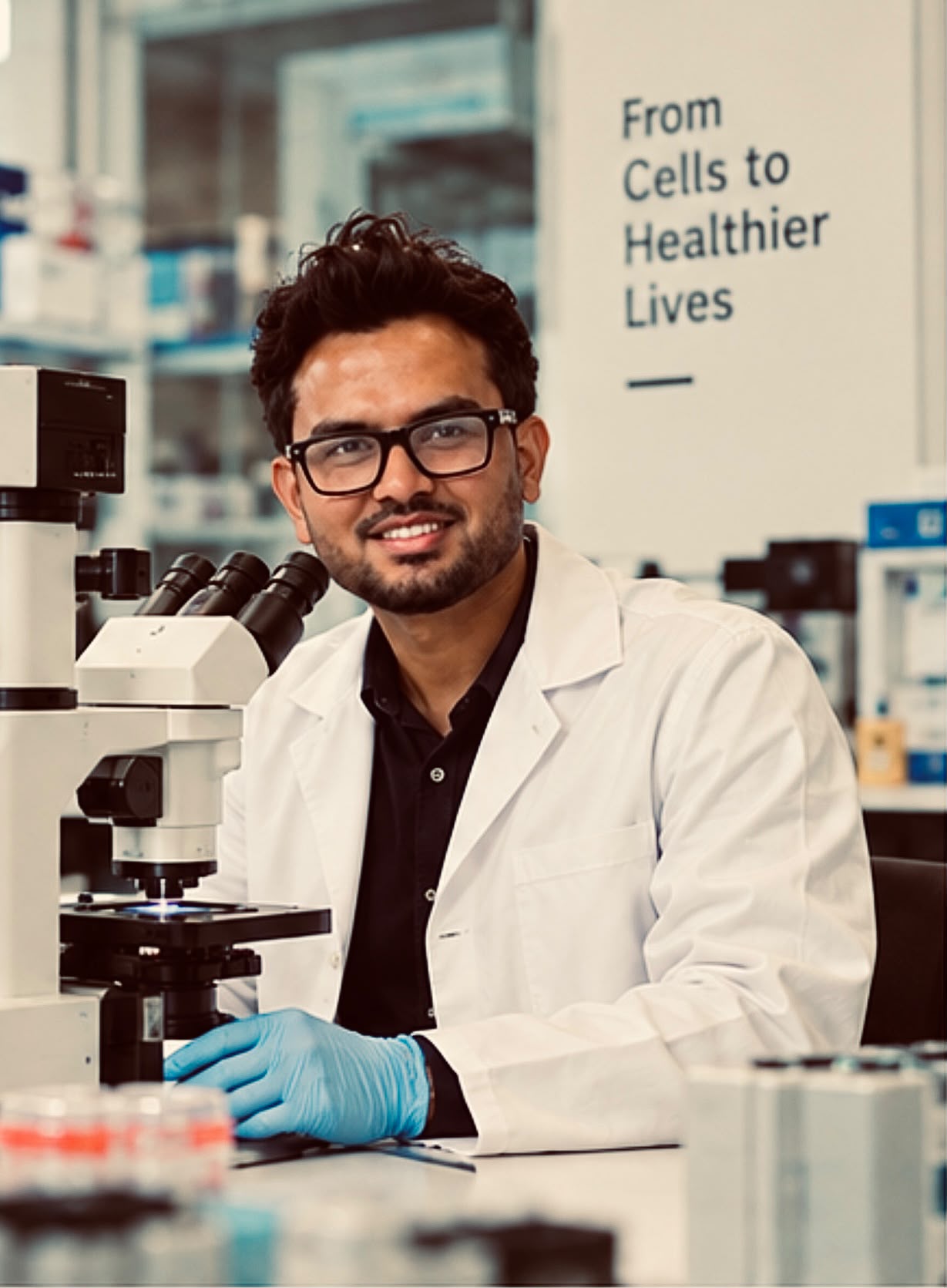
Alongside the PhD I supervise MSc projects at the University of East London and at the
Institute of Structural Molecular Biology, Birkbeck–UCL.
See supervision →
Research statement
Four problem areas, one methodological thread
01
Methods & multi-modal AI
I bring expertise in Bayesian frameworks, statistical analysis, and machine learning, with hands-on experience
using TensorFlow, PyTorch, and Scikit-learn.
The primary challenge in medical data lies in its high dimensionality, variability, and complexity, which can
hinder accurate predictions and insights.
To address these issues, I develop advanced AI models integrating multi-modal data sources, including EHRs,
genomic information, and medical imaging.
I apply deep learning techniques like CNNs and RNNs for robust feature extraction and pattern recognition.
By leveraging Bayesian optimisation and advanced statistical methods, I aim to enhance model interpretability
and reliability, ultimately developing AI-driven tools for personalised risk assessments and dynamic early
warning systems in healthcare.
Pursuing a PhD will enable me to refine these approaches further and contribute to transformative advancements
in AI-driven healthcare solutions.
02
Oncology
In oncology, the primary challenge lies in integrating and analysing heterogeneous data types, including
genomic sequences, histopathological images, and clinical records. These datasets' complexity and high
dimensionality hinder the accurate prediction of treatment outcomes and patient survival rates. My PhD
research will focus on developing advanced machine learning frameworks that effectively handle these data
challenges. By leveraging techniques such as deep learning and multi-modal data fusion, I will create
predictive models that integrate diverse data sources and provide interpretable insights into tumour behaviour
and treatment response. The goal is to develop a robust decision-support system that can assist oncologists in
personalised treatment planning, ultimately improving patient outcomes.
03
Epidemiology
Epidemiology faces significant challenges in handling large-scale, longitudinal datasets, often needing help
with missing data, bias, and complex temporal dependencies. These issues complicate the accurate estimation of
disease prevalence and the identification of risk factors. During my PhD, I will address these challenges by
developing novel statistical models and machine learning algorithms tailored for epidemiological data. I will
focus on creating methods to handle missing data through imputation techniques, reduce bias via causal
inference methods, and accurately model temporal trends using time-series analysis and survival models. The
outcome of this research will be the development of a comprehensive analytical toolkit that can provide more
accurate and actionable insights for public health interventions.
04
Cardiovascular
Cardiovascular data, encompassing EHRs, imaging data, and wearable sensor data, presents challenges regarding
data integration, real-time processing, and predictive accuracy. Data quality and noise variability further
complicate the extraction of meaningful patterns. My PhD research will focus on developing advanced machine
learning models that integrate these diverse data streams, enhance real-time predictive capabilities, and
provide personalised risk assessments. Using techniques such as convolutional neural networks for imaging data
and recurrent neural networks for time-series data from wearables, I aim to create a predictive system capable
of early detection and intervention in cardiovascular diseases, ultimately leading to improved patient care
and outcomes.
Announcements and Upcoming Talks in AI, ML, Deep Learning, and Federated Learning
USA Patent
1) Title: "Adaptive Bioelectronic Cardiovascular Surveillance Patch with Self-Healing Conductive Networks, Digital-Twin Analytics, and Closed-Loop Therapeutic Intervention"
Patent
Dual Valve Bioprinting Technology
• Concept: A 3D bioprinting system capable of producing customized, patient-specific valve replacements using
their cells. AI ensures precision during the printing and implantation process.
• Functionality: If both valves are damaged, printed replacements can restore full heart functionality without
the risk of rejection.
AI-Driven Cardiovascular Valve Repair Nanobots
• Concept: Nanobots deployed into the bloodstream that use AI to detect and repair microscopic valve defects.
These bots could deposit biocompatible materials or stimulate tissue growth to restore valve function.
• Functionality: The nanobots could operate non-invasively and repeatedly as needed, preventing damage
progression.